When we talk with shipowners about power systems, the conversation often starts around efficiency, fuel savings or emissions. These are certainly very important topics, but when you work closely with DC systems, you learn very quickly that the real cost of a power system isn’t decided during normal operation.
It’s decided the moment something goes wrong.
And in a DC system, that comes fast. From the instant a fault occurs, current can rise to destructive levels in microseconds. There’s no natural zero crossing, no time to wait. If the system doesn’t react immediately, voltage on the DC link can collapse and healthy parts of the system will be pulled down together with the faulty one.
By the time an alarm triggers, the outcome has already been set.
Why DC faults change the rules
This is a fundamental difference between traditional AC systems and modern DC distribution. AC systems have been more forgiving – faults develop more slowly and conventional protection devices, such as fuses, operating in milliseconds, have usually been sufficient. With DC, the physics are very different. Energy stored in capacitors, batteries and power electronics is released instantly. Protection has to act before that energy is allowed into the fault.
This is why ride-through capability cannot be treated as an add-on but has to be designed into the system from the start.
A common assumption is that redundancy alone will protect the vessel. More generators, more switchboards, more separation. Redundancy is important, but it doesn’t solve the problem of fast fault propagation. If a fault isn’t isolated selectively and quickly, redundancy simply means more equipment is affected at the same time.
What matters is selectivity – and speed.
Inside a DC-Hub, faults must be handled locally. This is why protection is built directly into inverter modules through Electronic DC Breakers (EDCBs). If a module fails, it must be disconnected within microseconds so the DC link remains stable, and the rest of the system continues operating. Waiting for a fuse to operate isn’t an option in DC systems – the damage is already done.
Between DC-Hubs, the same principle applies. Electronic Bus Links (EBLs) allow hubs to share energy efficiently during normal operation, but they must also be able to split the system instantly if a serious fault occurs. This ensures that a problem in one section doesn’t propagate across the vessel, even in large or highly redundant systems.
Batteries change the fault equation
Batteries introduce another layer of complexity. As battery systems grow larger, the amount of short-circuit energy behind them becomes significant. Battery Short-Circuit Limiters (BSCLs) are used to prevent that energy from being released into the DC system during a fault, enabling larger battery installations without increasing system risk.
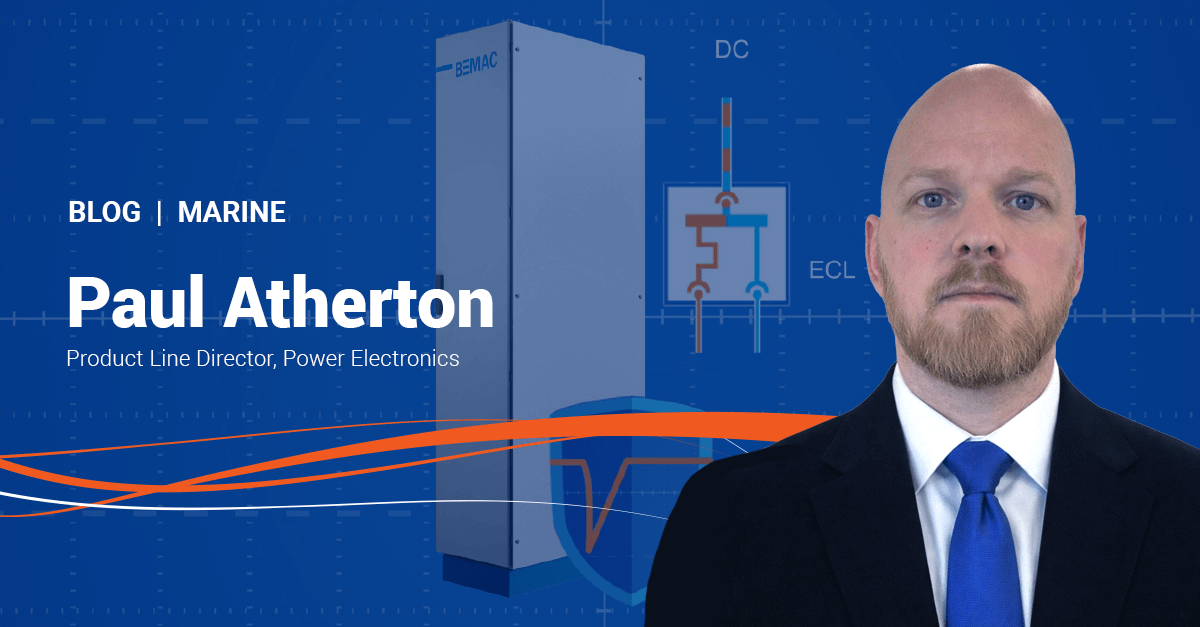
And when batteries are connected directly to the DC link, fast external protection becomes critical. Electronic Current Limiters (ECLs) ensure that faults outside the DC-Hub, on the battery side, don’t destabilize the DC link itself. Again, the goal is the same: contain the fault and keep the system alive.
When all of this works as intended, the difference is very clear in operation. A fault becomes a technical event, not an incident. The vessel continues running. DP capability, for example, in the offshore sector, is maintained long enough to exit the operation safely. In many cases, the system can simply be reset once the faulted component is addressed.
When it doesn’t work, even a small fault can result in a blackout.
None of these protection functions are visible when the ship is operating normally. Their value only becomes clear when something fails – which, over the lifetime of a vessel, inevitably will.
From a shipowner’s perspective, the cost difference between a contained fault and a cascading failure is substantial. Lost time, aborted operations, repair scope and confidence in the system are all decided before anyone has time to react.
That’s why, when we design DC systems here at The Switch, we spend so much time on failure behavior. Not because we expect things to go wrong, but because when they do, there’s no time to react. The fault has to be contained immediately.
Product Line Director, Power Electronics
Paul Atherton

Paul Atherton is General Manager of The Switch Marine Drives Norway and Product Line Director for Power Electronics. He has over 15 years of experience in the marine industry, focusing on power electronics, product development, operations, and business development. He holds a Bachelor of Engineering in Electronics from Bergen University College.