Electrification is steadily reshaping ship power systems across the maritime industry. From battery-powered ferries and hybrid offshore vessels to large container ships using shaft generators and power take-off systems, electrical machines are becoming a central part of modern vessel design.
However, the engineering challenges behind electrification can vary significantly depending on vessel size and operating profile. In many smaller commercial vessels, the main constraint is simply the amount of space available in the engine room.
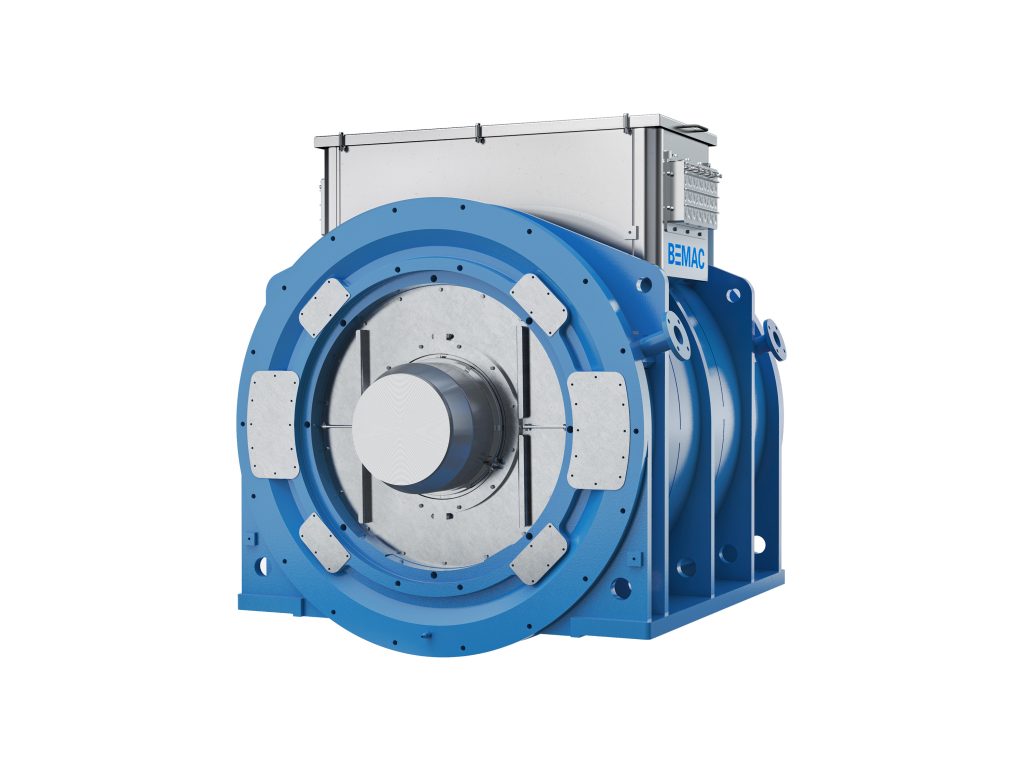
Engine rooms can be extremely compact, particularly in ships with narrow hull designs. As shipowners increasingly adopt hybrid propulsion systems, shaft generators and other electrified power solutions, designers need electrical machines that deliver high efficiency while still fitting into limited installation space. That challenge was one of the main drivers behind the development of our latest PMM850M permanent magnet (PM) machine.
An underserved market
In our PM machine portfolio, the smallest unit we have offered so far is the PMM1000M. These machines have been widely adopted and have accumulated extensive operating experience.
However, over time we began to see a clear pattern in the enquiries coming from shipowners and system integrators. For certain vessel types, even the PMM1000M may be too large.
In some markets, this is particularly visible. Japan, for example, has a large fleet of coastal vessels that are relatively small and narrow-hulled, where equipment dimensions quickly become a limiting factor in engine room design.
Customers were looking for a machine that could deliver the efficiency benefits of PM technology while fitting into those tight machinery spaces. In many cases, the required power levels were also lower than those covered by our existing portfolio.
To address this need, the smaller PMM850M is purpose-designed to operate in an envelope of roughly 500 kW to 1.5 MW, filling a gap at the lower end of our PM portfolio. This power range is typical for many vessels operating in regional and shortsea trades. Likely applications include smaller bulk carriers, product tankers and coastal trading vessels.
Why PM machines have become so popular
PM machines have increasingly become the standard for shaft generator cases over the past decade. Ten years ago, the situation looked quite different. At that time, conventional induction- and electrically excited machines were still widely used. The shift toward PM technology has been driven primarily by efficiency.
Ships rarely operate continuously at full power. Instead, they spend a large portion of their operating time at partial load. Under these conditions, PM machines offer a clear advantage. Compared with conventional machines, they typically achieve 2–4% higher electrical efficiency at rated power – and up to 10% when operating below full load.
The explanation lies in how the magnetic field inside the machine is generated.
In conventional machines, electrical power is required to maintain magnetisation. This demand remains even when the load decreases, reducing efficiency at lower operating points. PM machines do not require this magnetisation power. Because the magnetic field is created by permanent magnets, the machine can maintain higher efficiency across a wider load range.
Improvements of this kind can translate into meaningful fuel savings over the lifetime of a vessel. Higher efficiency also contributes to lower fuel consumption and reduced CO₂ and NOx emissions, helping shipowners comply with increasingly stringent environmental regulations.
Another advantage is mechanical simplicity. Permanent magnet machines use a brushless design, which eliminates several wear components present in conventional machines and helps reduce maintenance requirements.
The robustness of this design is reflected in our operational experience: more than 5 million operating hours in marine applications without any failures causing vessel downtime. This track record demonstrates strong reliability in demanding environments.
Cooling innovation
While efficiency is fundamental, compactness was equally important in the development of the PMM850M. In our larger PM machines, an air-liquid cooling unit with external fans is mounted on top of the machine. While effective, this increases the physical size and the complexity of the installation.
For the PMM850M, one of the key design decisions was to use water-jacket cooling instead of conventional air cooling. With water-jacket cooling, cooling water circulates through channels integrated directly into the machine housing and connects to the vessel’s freshwater cooling system. This allows the external cooling unit to be removed entirely. The result is a significantly more compact machine that can fit more easily into restricted engine room layouts.
Removing external cooling fans also lowers maintenance requirements. Since fans typically require replacement every now and then, eliminating them reduces the number of service items in the system. And there is also an acoustic advantage.
External cooling fans generate additional noise, so removing them helps ensure quieter operation. This is increasingly important as attention grows around underwater radiated noise (URN) and the overall acoustic performance of electric propulsion systems.
Engineering flexibility
The PMM850M can be delivered with or without bearings, depending on customer preference and application As with our other PM machines, it integrates easily into modern ship power architectures.
Its modular design allows the axial length of the machine to be scaled up or down according to the required power rating, enabling precise matching to specific operating requirements without oversizing. This scalability makes it suitable for both propulsion and shaft generator applications and supports various operating configurations, such as PTI/PTH.
So far, most of the permanent magnet machines we have supplied to marine customers have been used as shaft generators, converting mechanical power from the main engine into electricity for onboard systems. However, we are now seeing increasing interest in direct-drive electric propulsion as electrification spreads across a wider range of vessel types. Several propulsion projects are already underway, and I expect this trend to continue in the coming years.
Expanding portfolio in both directions
The PMM850M also reflects a broader strategy within The Switch’s marine business.
Over the past decade, we have gradually expanded our PM machine portfolio toward higher power levels by introducing larger machines. This includes the PMM1500M and PMM2000M for demanding applications such as LNG carriers and giant container vessels of up to 24,000 TEU.
With the PMM850M, we are extending the portfolio in the opposite direction.
By moving below the 2 MW power level, we can support a wider range of power requirements and ensure that PM technology can be applied across more shipping segments.
Enabled by a scalable platform, our PM machine portfolio now includes more than 70 variants, covering a power range from roughly 500 kW to over 10 MW.
As electrification continues to reshape how ships generate, distribute and manage onboard power, efficient electrical machines are becoming a central component of modern ship power systems. At the same time, compact and reliable PM machines play an increasingly important role in enabling flexible, efficient and future-ready vessel designs.

Product Line Director, Electric Machines
Jussi Puranen

Jussi has nearly 2 decades of experience in R&D and product development of electrical machines, and his main responsibilities are the product management and R&D of electric machines (especially PM machines). Puranen holds an M.Sc. (Technology) degree in Electrical Engineering and a D.Sc. (Technology) degree from the Lappeenranta University of Technology (LUT), Finland.