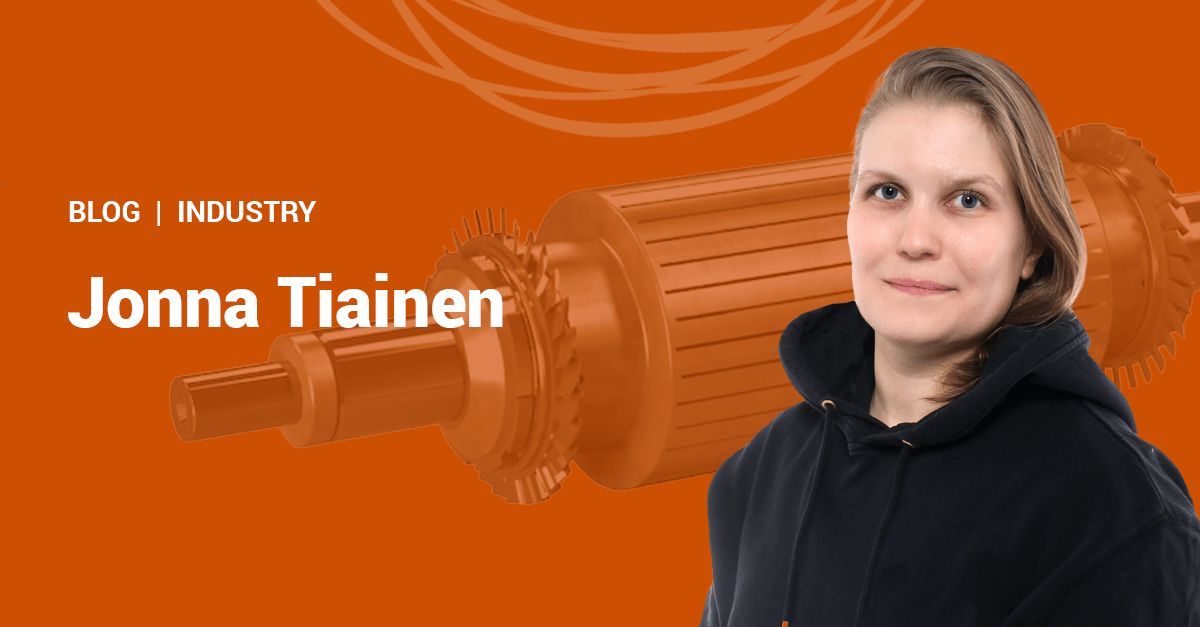
High-speed solid rotors are seeing increasing application across industry. At the same time, customers are demanding even greater rotational speeds and power densities – well beyond the traditional operating ranges of 6,000 to 20,000 rpm.
Conventional manufacturing methods, however, limit the development of large commercial high-speed solid rotor machines, particularly those exceeding 1,600 kg in mass and 2 meters in length. Meeting customer demands therefore calls for new, state-of-the-art manufacturing approaches.
This is where collaborative research between LUT University and The Switch comes in. Together, the long-standing partners are developing new technologies for high-speed solid rotors.
High-speed solid rotor machines present a number of unique design challenges. Two that LUT–The Switch collaboration is working on today are:
- Simplifying the multidisciplinary interactions involved in designing high-speed machines for heat pumps
- Developing ways to ensure that system dynamics are fully considered in any design incorporating active magnetic bearings (AMBs)
Multidisciplinary design challenges for heat pumps
The design of industrial-scale heat pumps requires the close involvement ofexperts from multiple disciplines, including:
- Electromagnetism
- Cooling
- Fluid dynamics
- Rotor dynamics
- Mechanical strength
- AMBs
- Control systems
Because these fields are closely connected, any change in design made to meet the needs of one discipline affects all the others. According to Professor Jussi Sopanen of the LUT School of Energy Systems, this interrelatedness creates a situation where everyone must adapttheir requirements. “When all are unhappy, then the design is good.”
A smooth and efficient design methodology is essential for coordinating the requirements of multiple disciplines.
LUT and The Switch have been developing design methodologies, tools and processes to manage these differing perspectives and technical requirements. The ultimate goal is speeding up the design loop and ensuring that only feasible and reliable solutions emerge. To support this work, the partners are also exploring the use of AI-assisted design tools. Another key heat pump research topic is developing a thorough understanding of the material compatibility between the electric machine’s winding insulation and the cooling medium in hermetically sealed high-speed machines.
AMB design challenges
AMBs offer minimal energy losses, oil-free operation and excellent controllability – all valuable features for high-speed electric machines.
However, the significant differences between AMBs and other bearing types must always be carefully considered.
Today, one of the most important challenges in AMB model-based control is understanding system dynamics. Both the rotor of the electric machine and the load attached to it must be accurately represented in the model to ensure that rotor dynamics and AMB control are properly matched to each specific system. This requires close collaboration between the motor manufacturer and the customer already at the design stage.
Control tuning is also an ongoing challenge. While it can often be accomplished through software adjustment, sometimes it requires design changes to the AMB layout to meet performance requirements. Despite the great flexibility provided by software, physical boundaries and material laws still cannot be broken.
Building on these challenges, LUT is currently researchingmulti-bearing solutions that can increase AMB system performance beyond today’s limits. They are also studying the use of AMBs in mobile platforms such as marine vessels and other vehicles.
Future AMB research projects include:
- Improving model-based control methods
- Developing better AMB actuators
- Enabling commissioning of AMBs without manual tuning, possibly with the use of AI
Manufacturing methods, insulation materials and further investigations of magnetic materials are other research topics being considered.
Long history of fruitful collaboration
LUT University’s years of collaborative research have led to many successful commercial results. Their research into solid rotors in the late 1980s evolved into industrial applications within just a few years. The resulting start-up company Rotatek later grew into today’s The Switch. To date, The Switch has supplied more than 1,000 high-speed solid rotor machines for various industry applications with zero rotor failures.
Some other important The Switch milestones include:
- In 1999, high-speed motor deliveries for vacuum blower applications in paper mills began. Since then, more than 900 motors have been delivered.
- In 2018, the first machine with water-jacket cooling for marine applications was delivered. More than 200 motors have been delivered to date.
- In 2020, a standard solid rotor machine with modular options was introduced.
When The Switch recognized the need for oil-free motor compressors in the early 2000s, the company approached LUT to develop affordable AMB technology. At the time, AMBs were still very expensive, with limited design methodology and low performance.
LUT’s Laboratory of Control Engineering began developing AMBs for high-speed machines, looking more carefully at their electromagnetic design and control. This led to a study of rotordynamic modeling.
The work helped reduce the cost of AMBs and improve their performance. It also eventually led to the creation of SpinDrive, a Lappeenranta-based company with over 10 years of activity.
20 years later, LUT is one of the leading universities in AMB technology, and its research in the field is still very active. Their work has also supported the industrial application of AMB technology at The Switch. In 2019, the first The Switch machine with AMBs was delivered.
The future looks bright
These and other successful outcomes demonstrate that close collaboration between industry and academia is essential for future progress.
If you are interested in discussing your particular needs or learning more about our current research, please get in touch!

R&D Project Manager
Jonna Tiainen

Jonna Tiainen currently works as R&D Project Manager at The Switch, Finland. She has a background in turbomachinery and over a decade of experience in Computational Fluid Dynamics, measurements, project management and teaching. Tiainen holds a D.Sc. (Tech.) degree in heat transfer and fluid dynamics from the LUT University, Finland.