Imagine that your electric machine no longer meets your needs. Perhaps performance requirements changed, vibrations suddenly appeared during operation or another practical challenge emerged.
Situations like these are where innovation often begins. For engineers, solving such problems is part of everyday work – but how they approach them can vary from company to company. At The Switch, tackling complex challenges is at the core of what we do. With a strong emphasis on innovation and deep analytics, we design electric machines we can be genuinely proud of. In this article, I’ll share what goes into innovation at The Switch.
Meet the innovation department
Our development engineering team transforms electromagnetic calculations into manufacturable products. In practice, this means developing product structures and mechanical engineering for electric machines.
Our approach is built on a strong problem-solving mindset and the ability to see beyond the horizon. Curiosity about new technologies and the readiness to step out of the box – or even kick the box completely aside – are equally valuable assets. Regardless of the application, we always aim to create the best and most robust machines – both electrically and mechanically – operating as cost-efficiently as possible.
How ideas take shape
In most cases, product development is an iterative process where the final result can differ significantly from the first draft. Yet innovation always begins with that very first draft.
As mentioned, most innovations start with a real-world problem. Once such a challenge is identified, we often use classic brainstorming sessions to explore possible solutions. In this process, all ideas are welcome. Even the wildest ones can lead to feasible solutions – with some adjustments. Once an idea starts to take shape, the next step is to transfer it into a 3D model or other software. This is followed by technical board meetings, where some ideas get shot down while others move forward toward patent applications.
The importance of IPR and patenting
In highly competitive industries, intellectual property rights (IPR) and patenting are essential considerations. There are many reasons patenting is required. The first is to protect a high-value innovation from competition. Another is to prevent anyone else from patenting something we use, even if the innovation itself has relatively low commercial value.
We also try to keep up with relevant patents filed by others. At the very least, we review patents related to existing technologies when creating new products.
One would think that electric machines are such an old product that everything has already been invented. It’s surprising how much development is still going on!
A recent case
Since most solutions come out of routine work, engineers often don’t see them as innovations. However, the fact that many of them are patented tells a different story.
In one recent case, our propulsion machines needed a safe way to slowly rotate the shaft line for emergency disconnects. With electrical propulsion, there is no diesel engine with a turning gear to enable slow shaft rotation, so the team set out to find a solution.
After some sketching, we arrived at a relatively simple yet novel concept that led to a patent. It’s a good reminder that what feels like a routine solution to everyday engineering challenges can still turn out to be a true innovation.
Reliable, long-lasting results
And we don’t stop at finding solutions. We want to know how they operate in the real world. Therefore, we work closely with the performance team during sea trials, carefully analyzing operational data. If any issues are found in the field, we use this information to improve the next product. We can even go as far as advising shipyards on structural aspects needed to ensure smooth machine operation.
Although all this creates additional work for us, we find it essential for making sure our machines perform optimally. By taking these extra steps, we ensure that all parties are fully satisfied with the end product – whether it’s a smoothly sailing ship, a reliable mining machine or a submerged tidal turbine.
Our focus on innovation and in-depth studies has made our products some of the most reliable on the market. Although a meticulous approach to product development can sometimes make the upfront work longer, the long-term results justify the investment.
Have you encountered a challenging issue in your application? Or are you looking for an adaptation, a new use or a custom solution?
Get in touch! We’d love to help.
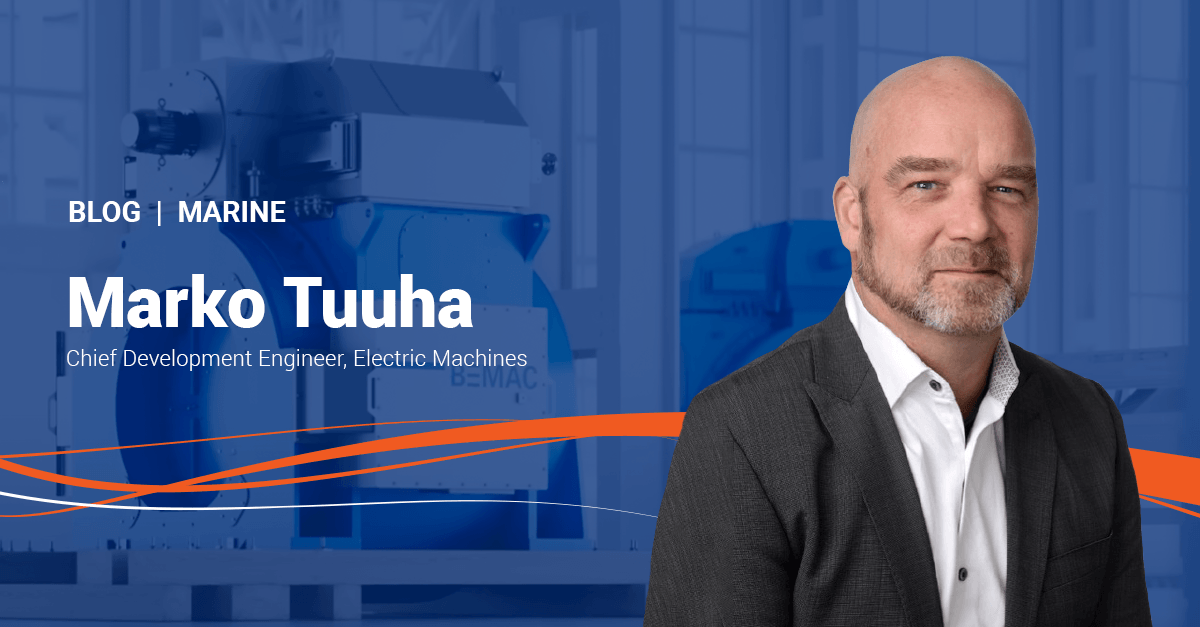
Chief Development Engineer, Electric Machines
Marko Tuuha
Marko Tuuha leads the mechanical development engineering team for rotating machines. He is also actively involved in product development, working on new electric machine designs for different applications. He has been working in mechanical engineering since 1999, with experience ranging from paper machinery to electric machine development for marine applications. For the past 20 years, his work has focused on rotating electric machines, contributing to the development of numerous product prototypes with innovative solutions. Outside of work, Marko enjoys DIY crafting, particularly working on vintage cars and motorcycles.