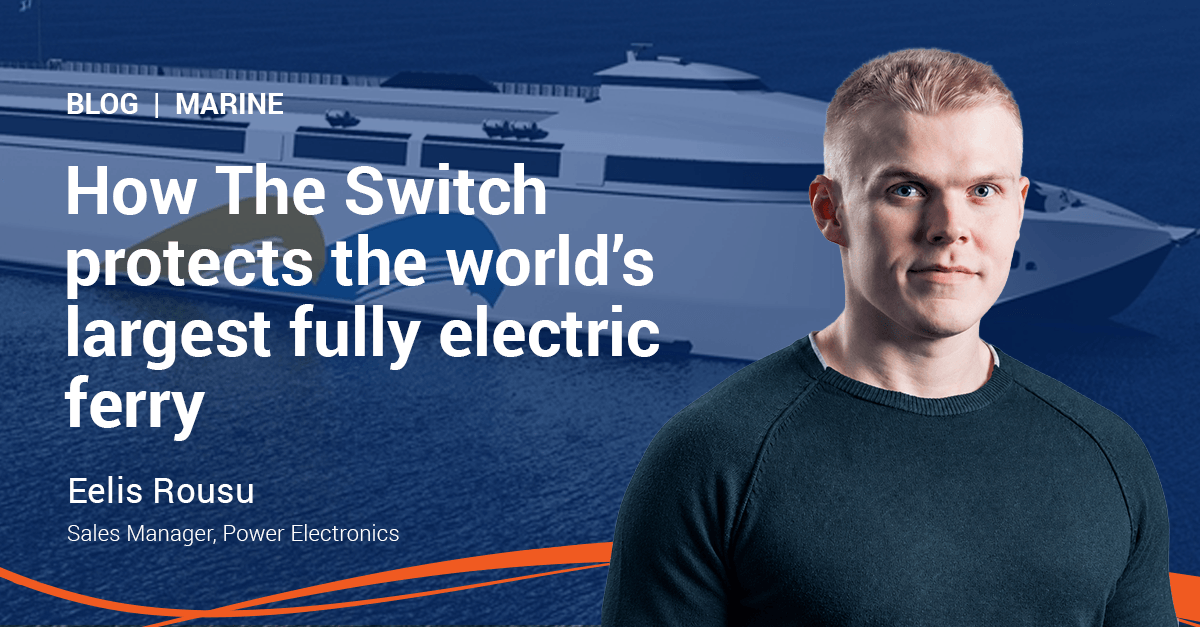
The world’s largest fully electric vessel will soon be plying the waters between Uruguay and Argentina. Its electrical safety is ensured by The Switch.
Built by Australian shipbuilder Incat for South American ferry operator Buquebus, the 130-meter catamaran Ro-Pax ferry China Zorrilla arrived in Uruguay in September. The vessel is expected to begin ferrying passengers across the Rio de la Plata between Uruguay and Argentina by the end of October, making the hour-long, 55-kilometer trip six times a day.
Demonstrating the viability of large-scale fully electric vessels
Originally planned for diesel and LNG propulsion, Incat and Buquebus later decided to make the ferry fully electric instead. The change to electric propulsion reduced the vessel’s overall weight, allowing the use of smaller water jets. The high-strength naval aluminum structure and optimized hull design further lowered the weight.
Key specifications include:
- A battery package four times larger than any previously installed on a vessel
- Over 5,000 lithium-ion modules weighing more than 250 tons, arranged in 12 arrays in four separate insulated rooms
- Energy storage capacity of more than 40 MWh
- Eight 2,400 kW electric motors driving electric water jets, with two fixed and two movable jets in each hull
- 15 MW chargers at each terminal, enabling a full charge in 80 minutes and enough charge for the short voyage in just 40 minutes
The vessel’s performance meets all operator’s requirements for high power, fast acceleration, efficiency, reliability and flexibility. Capable of carrying 2,100 passengers and 225 cars at a service speed of about 25 knots, China Zorrilla doubles the capacity of the largest ship previously operated by Buquebus.
And because China Zorrilla is a much lighter vessel with highly optimized energy consumption, one of South America’s busiest ferry routes will be 100% emissions free, reducing carbon dioxide emissions on the route by as much as 37,545 tons annually. In addition, electric propulsion brings dramatic reductions in vibration and noise, creating a quieter and more comfortable journey for passengers. Uruguay and Argentina also produce a lot of their energy from renewable energy sources, and Uruguay has one of the cleanest electrical grids in the world.
Short-circuit protection paves the way
The vessel’s size and power are made possible by a purpose-built protection system from The Switch.
Power architecture is a defining factor when scaling from small hybrid vessels to large, fully electric vessels. DC systems are compact, minimize conversion losses, improve system stability and redundancy, and integrate seamlessly with energy storage systems. Together, these benefits contribute to greater electrical efficiency.
But once a DC-based architecture is selected, electrical safety becomes critical.The Switch’s purpose-built power electronics were chosen to safeguard power flow on China Zorrilla because of their ultrafast protection response.
In collaboration with system integrator Wärtsilä, The Switch delivered the main DC switchboards and charging stations in Argentina and Uruguay. The Switch DC-Hub serves as the main electrical DC switchboard, connecting battery power to all consumers, including electric propulsion and hotel loads. The Switch protection devices – Electronic Current Limiters (ECLs), Battery Short-Circuit Limiters (BSCLs) and Electronic DC Breakers (EDCBs) – connect the large battery safely and cost-efficiently to the electrical system. The Switch power electronics also enable battery shore charging.
Large-vessel electrification now a reality
China Zorrilla demonstrates that large-scale, high-capacity electric ferries have what it takes to succeed commercially. The technology is already here, and with the right combination of system integrators and technology partners, the transition to electric propulsion is within reach.
Battery technology continues to improve, and with advanced power electronics ready to support these systems, the era of large-scale fully electric vessels has arrived. In the future, similar solutions can be applied, for example, to container vessels, offshore construction ships and ferry retrofit projects.
If you’d like to discuss electrifying your next ferry project, get in touch. We’re ready to talk!

Sales Manager, Power Electronics
Eelis Rousu

Eelis Rousu, M.Sc. (Tech.) (Electrical Engineering), M.Sc. (Economics & Business Administration), works as Sales Manager, Power Electronics at The Switch. Eelis has been at The Switch in various engineering and sales roles since 2019, including positions in software applications, sales engineering and key account management. Today, Eelis is responsible for sales of power electronic solutions for marine and industrial applications.