Recent geopolitical tensions in the Middle East have driven energy prices sharply upward, further pushing the global transition away from fossil fuels. Across industries, this shift is becoming increasingly urgent – and in the maritime sector, it is reinforcing the business case for electrification.
As fuel costs rise and emissions regulations tighten, electrification is reshaping ship power systems. From battery-powered ferries and hybrid offshore vessels to large container ships utilizing shaft generators and power take-off systems, electrical machines are becoming central to modern vessel design. In particular, the adoption of electric propulsion is now gaining momentum across a growing range of vessel types.
Permanent magnet technology
All our marine machines are based on permanent magnet (PM) technology, which we have successfully deployed for over two decades in marine, offshore wind and industrial applications. Only in marine, we have accumulated well over five million operating hours with a strong reliability record.
The key advantage of PM technology lies in its ability to generate a magnetic field without external excitation. Unlike conventional electrically excited machines, PM machines eliminate the need for additional energy input to create a magnetic field.
In marine applications, this translates directly into higher efficiency and lower fuel consumption – whether in main engines driving shaft generators or gensets powering electric propulsion systems.
At rated load, PM machines typically deliver efficiency improvements of 2–4% compared to conventional machines – and up to 10% at partial load.
For vessels that still burn fuel in internal combustion engines as their primary energy source, these gains result in substantial fuel savings over time – and consequently lower emissions.
For fully electric vessels powered by batteries, higher motor efficiency extends operational range – an important advantage in range-sensitive applications.
In addition, the brushless design of PM machines makes them mechanically simple and inherently reliable, reducing maintenance requirements and improving lifecycle performance.
Shaft generator platform
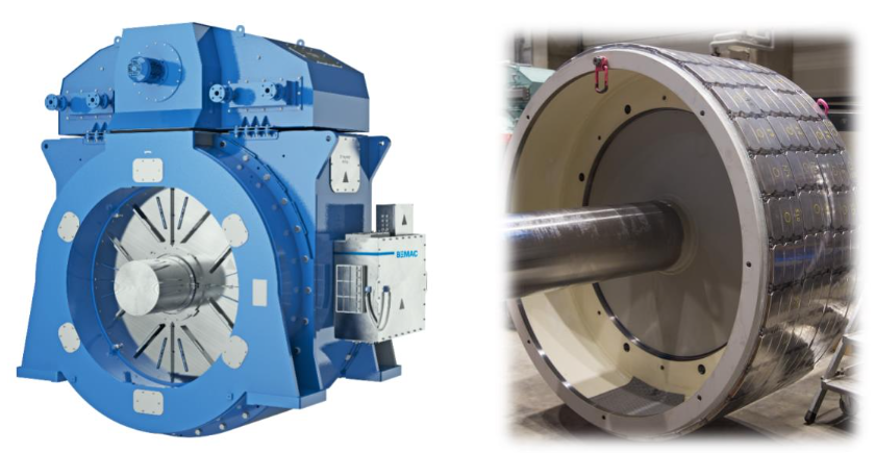
Our PM shaft generator portfolio currently includes five frame sizes, covering a power range from 500 kW to over 12 MW. The platform is modular and highly scalable, allowing straightforward customization to meet specific customer needs.
In essence, the axial length of the machine can be adjusted to match power and speed requirements, ensuring optimal performance for each installation.
Over the years, we have continuously refined our designs – both incrementally and through larger updates – based on feedback from end users in real operating conditions.
Extending into electric propulsion
The first of The Switch’s direct-drive propulsion motors is already in operation on board the M/S Nukumi, operated by Canada Steamship Lines. This vessel utilizes DC power distribution, enabling variable-speed operation of gensets without increasing overall system complexity relative to traditional AC-based systems.
This approach allows genset speeds to be optimized for fuel efficiency based on vessel speed and onboard power demand. In addition, DC distribution simplifies the integration of future energy sources such as batteries and fuel cells, enhancing long-term flexibility and future-proofing the vessel.
However, classification society rules often require redundancy in propulsion systems. A single electric motor is typically not sufficient unless an alternative propulsion source – such as a retractable thruster – or a twin-propulsion setup with two shaft lines is available.
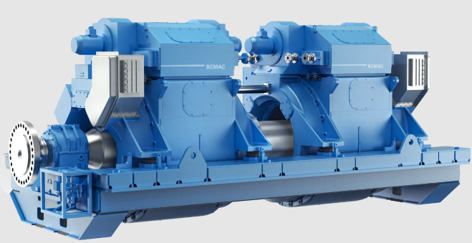
To address this, The Switch has developed a tandem motor concept. This solution integrates two independent motors into the same propulsion line to maintain redundancy. If one motor fails, it can be mechanically decoupled, allowing the remaining motor to continue driving the propeller.
Although this results in a 50% reduction in propulsion power, the cubic relationship between propeller power and speed means the vessel can still achieve up to 80% of its maximum speed, ensuring safe and efficient operation.
The tandem concept can be implemented either as two separate motors mounted on a common bedframe or as an integrated solution with a very short axial length.
These propulsion systems can be delivered with or without bearings and shafts, depending on customer preferences. For vessels with dual propulsion lines or other redundant systems, our existing shaft generators can also be configured with sleeve bearing and shafts. This flexibility allows us to tailor solutions to match a wide variety of vessel designs and operational needs. The Switch has already secured its first customer projects using this concept with a major system integrator, with initial deliveries scheduled for early 2027.
Scaling downward with PMM850M
Until recently, our smallest frame size – PMM1000M – has typically been used in 1–2 MW direct-drive applications. However, space constraints in smaller bulk carriers, product tankers and coastal vessels have driven the need for a more compact solution.
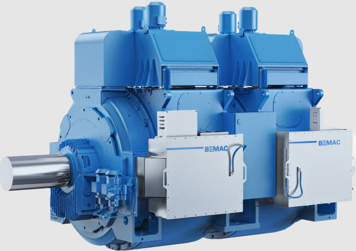
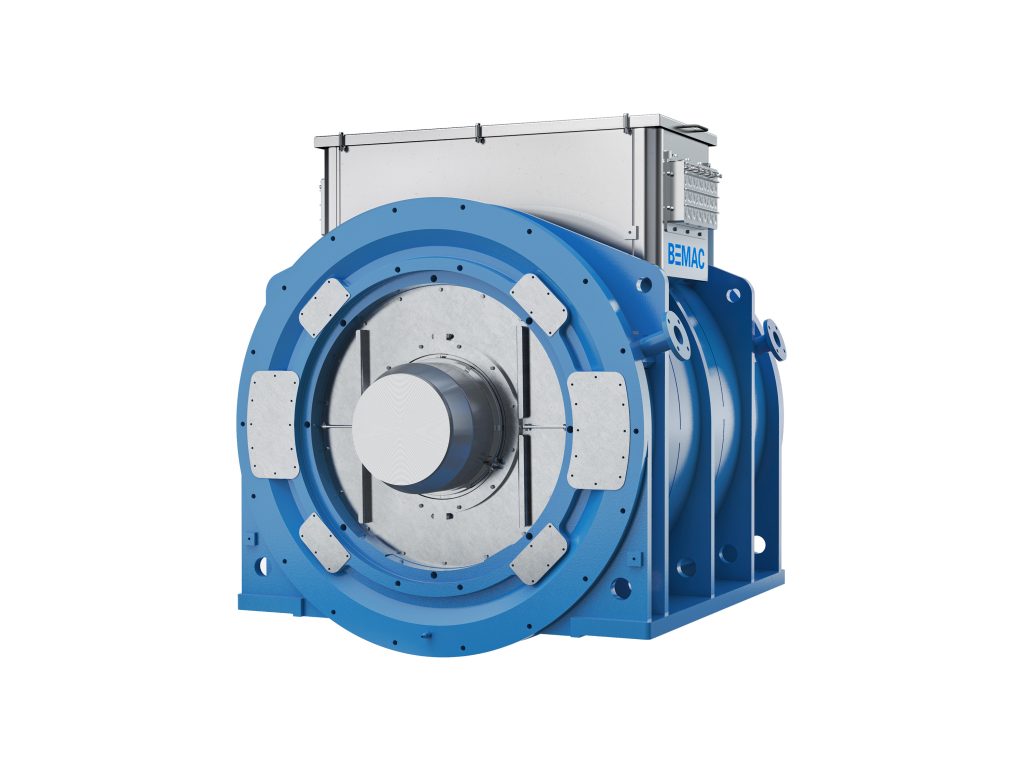
To address this, we have developed a new frame size: PMM850M.
A key feature of this machine is its integrated water-jacket cooling system, which replaces traditional cooling units with blowers and heat exchangers. This design significantly improves compactness, reduces maintenance requirements and makes the machine particularly well suited for noise-sensitive applications.
Like our other machines, the PMM850M can be used both as a shaft generator and a propulsion motor. It is currently in the manufacturing phase, with prototype verification expected by the end of 2026. The planned power range is 500 kW to approximately 2 MW.
The addition of the PMM850M into our product portfolio enhances flexibility in equipment selection, especially for space-constrained installations.
Growing demand for PM technology in propulsion
For many deep-sea vessels, permanent magnet shaft generators have become a preferred solution due to their clear advantages over genset-based systems. Key drivers include fuel savings – often resulting in a payback period of just 2–4 years – and easier compliance with IMO regulations such as EEXI and CII.
Since delivering our first PM shaft generator in 2015, we have sold nearly 600 units. Around 400 of these are currently in operation, collectively accumulating over five million operating hours without major faults.
In recent years, interest in electric propulsion has expanded to larger vessels, driven by both genset-based and battery-powered solutions. Advances in battery technology now make fully electric operation feasible for distances exceeding 100 nautical miles.
This growing interest is translating into concrete demand: we have already secured nearly 30 orders for megawatt-class propulsion applications.
With the introduction of the tandem motor concept and the new PMM850M frame size, we believe our portfolio is well positioned to support this transition across an ever-wider range of vessel types, including container ships, gas carriers, tankers or narrow-hull coastal vessels.
While permanent magnet technology has long been an economically sound choice, the recent rise in fuel prices has made it more compelling than ever.

Product Line Director, Electric Machines
Jussi Puranen

Jussi has nearly 2 decades of experience in R&D and product development of electrical machines, and his main responsibilities are the product management and R&D of electric machines (especially PM machines). Puranen holds an M.Sc. (Technology) degree in Electrical Engineering and a D.Sc. (Technology) degree from the Lappeenranta University of Technology (LUT), Finland.